Best Microfiber Towels for Cars in 2026: A Detailer's Complete Guide
By Alex B., Master Detailer | Fresh Layer Mobile Detailing | San Diego, CA
The best microfiber towels for cars in 2025 are the Rag Company Twist Loop 1100 GSM for drying, the Edgeless 365 for wax and polish removal, and the Standard Waffle Weave for glass — and those three towels cover 90% of what any car owner or detailing enthusiast needs.
At Fresh Layer, we use this exact lineup on every job we run across San Diego County. This guide breaks down each towel, explains how to read GSM and fiber blend specs, and tells you which towel to reach for at every stage of a detail — so you stop guessing and stop causing the micro-scratches that cheaper or wrong-use towels leave behind.
Quick Reference: Which Towel for Which Job?
Before getting into specs, here's the short version for people who want a fast answer:
| Task | Towel Type | Ideal GSM | Best Blend |
|---|---|---|---|
| Drying (all vehicles) | Twisted loop drying towel | 800–1,100 | 70/30 |
| Drying (dark/coated cars) | Twisted loop, high pile | 1,100+ | 70/30 |
| Wax and sealant removal | Dual-pile or edgeless | 350–500 | 70/30 |
| Polish buffing | Edgeless | 365–400 | 70/30 |
| Ceramic coating buffing | Terry or edgeless | 300–400 | 80/20 or 70/30 |
| Window and glass | Waffle weave | 200–300 | 70/30 |
| Interior surfaces | Flat-weave or terry | 200–400 | 70/30 |
| Hand washing | Waffle or terry | 300–400 | 80/20 |
Keep this table bookmarked. Most scratch and swirl damage comes from using the right towel in the wrong situation — not from buying a bad towel.
What Makes a Microfiber Car Towel Different from a Regular Towel
Microfiber is a blend of ultra-fine polyester and polyamide (nylon) fibers split during manufacturing to fractions far finer than a human hair. That splitting process creates millions of tiny wedge-shaped fiber hooks per square inch — and those hooks trap dirt, grit, and moisture inside the towel instead of pushing them across the surface of your paint.
A standard cotton terry cloth drags particles across your clear coat. Microfiber lifts them off. That mechanical difference is why professional detailers stopped using cotton decades ago.
But microfiber itself varies enormously in quality. Two specs control almost everything: GSM and fiber blend ratio.
GSM: The Number That Tells You What a Towel Is For
GSM stands for grams per square meter. It measures how much fiber is packed into each square inch of the towel — which translates directly to absorbency, plushness, and surface safety.
200–350 GSM — lightweight towels for glass, dashboards, and interior surfaces where you need feel and precision over bulk. These are your detail cloths.
350–600 GSM — the all-purpose range. Wax removal, quick detailing spray, sealant buffing, polishing compound cleanup. This range balances absorbency with maneuverability.
600–1,100+ GSM — high-absorption drying towels and final-buff towels. The fiber density creates a cushion between the towel face and your paint, which is what makes them safer for the drying step where most paint damage happens.
Choosing the wrong GSM for the job is one of the most common detailing mistakes. Using a 1,100 GSM towel on glass is clumsy and leaves more product on the surface than it removes. Using a 250 GSM towel to dry a just-washed car means more passes, more surface contact, more risk.
Fiber Blend: Why 70/30 Beats 80/20 for Paint
The blend ratio describes the percentage of polyester to polyamide in the towel's construction.
80/20 (polyester/polyamide): More polyester means a stiffer, more durable towel. Better for scrubbing interior surfaces, washing exterior panels by hand, or any task where you need the towel to hold its shape under pressure. Less suitable for paint — the higher polyester content creates slightly more friction against clear coat.
70/30 (polyester/polyamide): More polyamide means a softer, more absorbent fiber. This is the professional-grade standard for anything touching paint or glass. The additional nylon content increases the fiber's ability to hold water and increases the softness of surface contact.
If a towel's blend ratio isn't listed on the packaging, that's a red flag. Reputable manufacturers publish this because it matters.
Edge Type: Edgeless vs Overlocked
Overlocked edges have a stitched border that reinforces the towel. That stitching is durable, but it's also a harder surface that can catch on a panel edge or drag across paint if you're not careful. Fine for interior work, not ideal for paint.
Edgeless towels are hemmed with soft microfiber binding or ultrasonic-cut so there's no hard edge anywhere on the towel. For anything touching painted surfaces, edgeless is the only smart choice.
The difference in cost between an overlocked and an edgeless towel is usually under two dollars. The difference in what a misused overlocked edge can do to a fresh paint correction job is several hundred.
Pile Height: The Overlooked Spec That Matters Most for Drying
Pile height describes how long the individual fibers extend from the towel's base weave. High-pile towels keep the base fabric — the denser, harder-weave backing — further from your paint surface. During drying, even a freshly rinsed car retains microscopic particles. High pile means those particles sink into the towel and away from the panel, rather than riding between the towel face and the clear coat.
This is why a 1,100 GSM twisted loop drying towel is safer than a 600 GSM flat-weave towel at the same price. The twisted loop construction stacks fiber density vertically, creating more pile height per square inch.
The 5 Best Microfiber Towels for Car Detailing in 2026
These are the detailing microfiber towels our team at Fresh Layer carries on every job. We've tested these across hundreds of vehicles in San Diego — everything from base-coat Civics to ceramic-coated Teslas and freshly painted show cars.
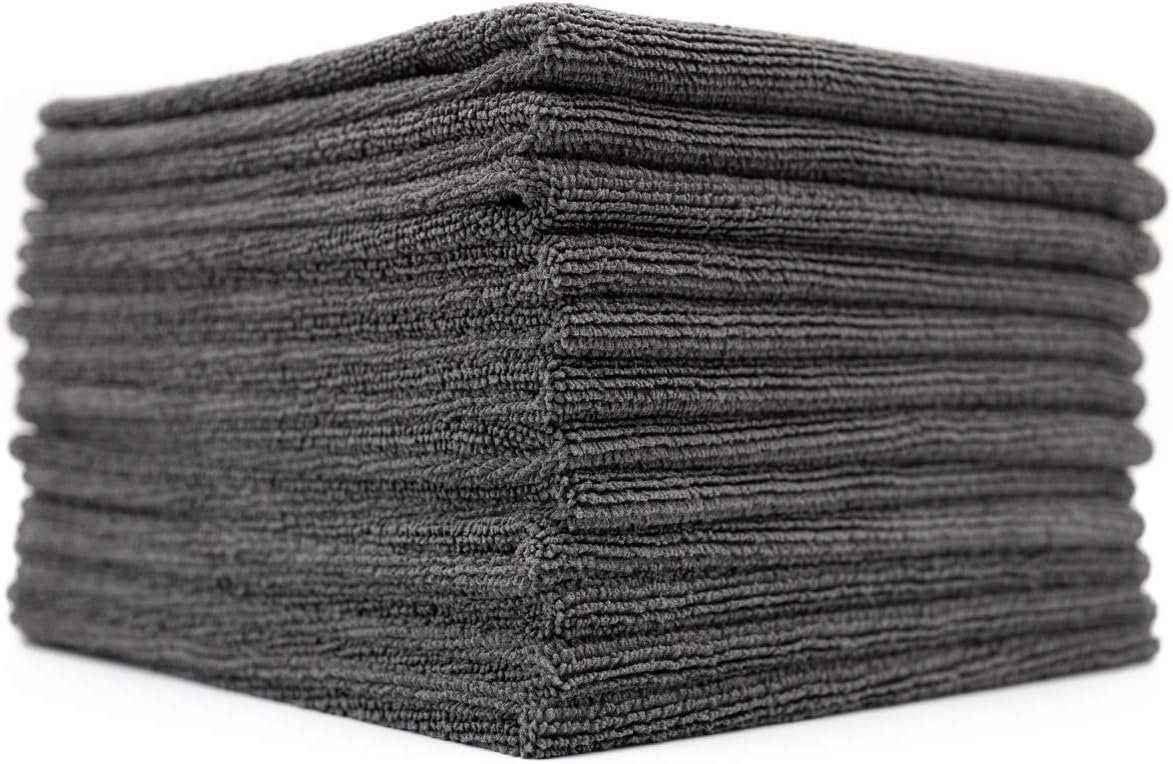
Terry Towels
-
Ideal for polishing and buffing, especially for delicate surfaces.
-
Typically ranges from 300 to 400 GSM.
-
Generally, they cost between $1 to $5 per towel, depending on size and quality.
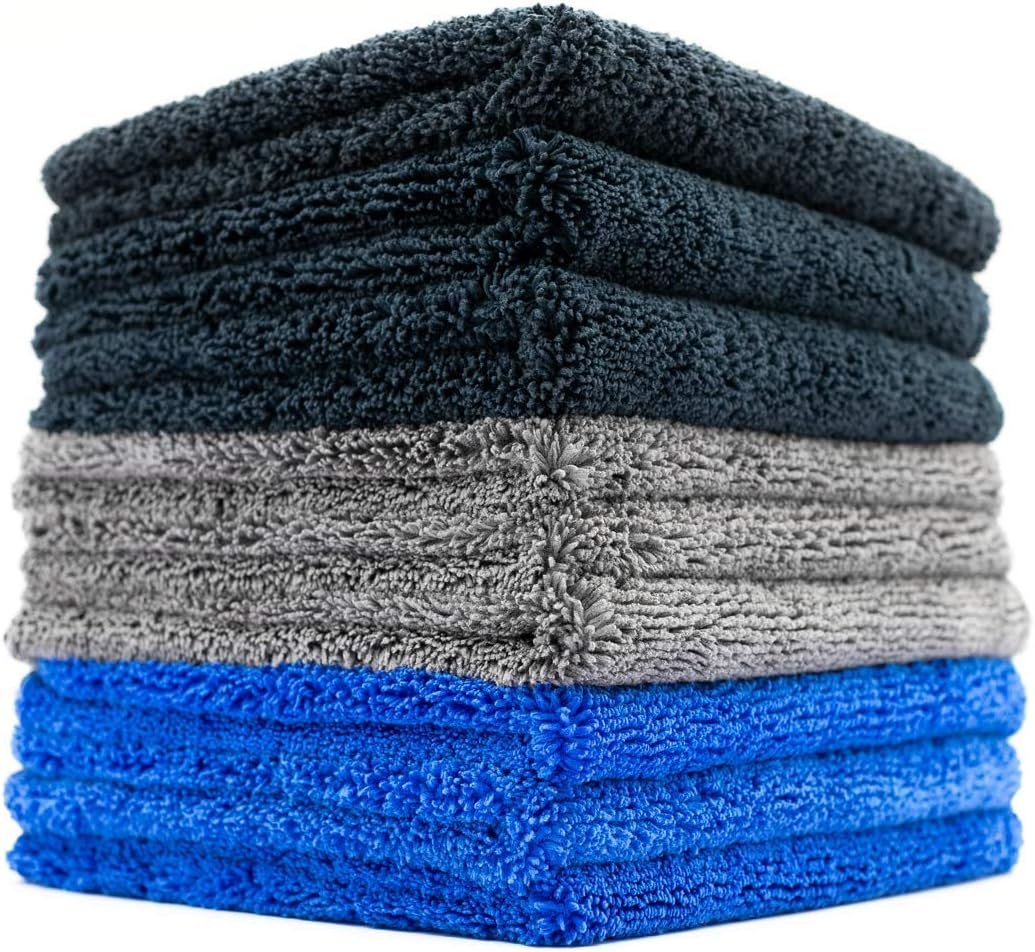
Dual-Pile Towels
-
One side for waterless washing or quick detailing, the other for removing wax or sealants.
-
High GSM, typically around 500 to 700 GSM.
-
Around $5 to $10 per towel.
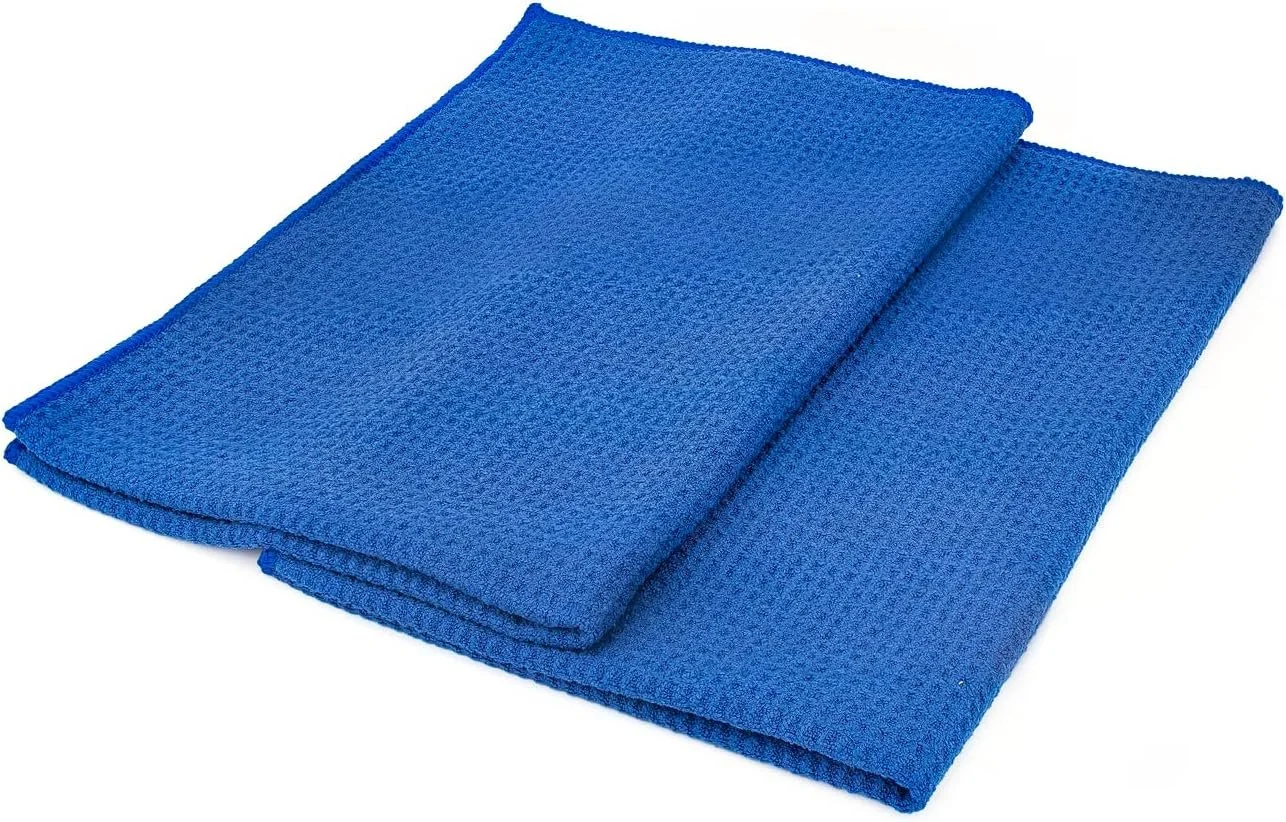
Waffle Towels
-
Best for windows because of their high absorbency and less streaking.
-
Usually around 350 to 500 GSM.
-
Around $2 to $7 per towel.
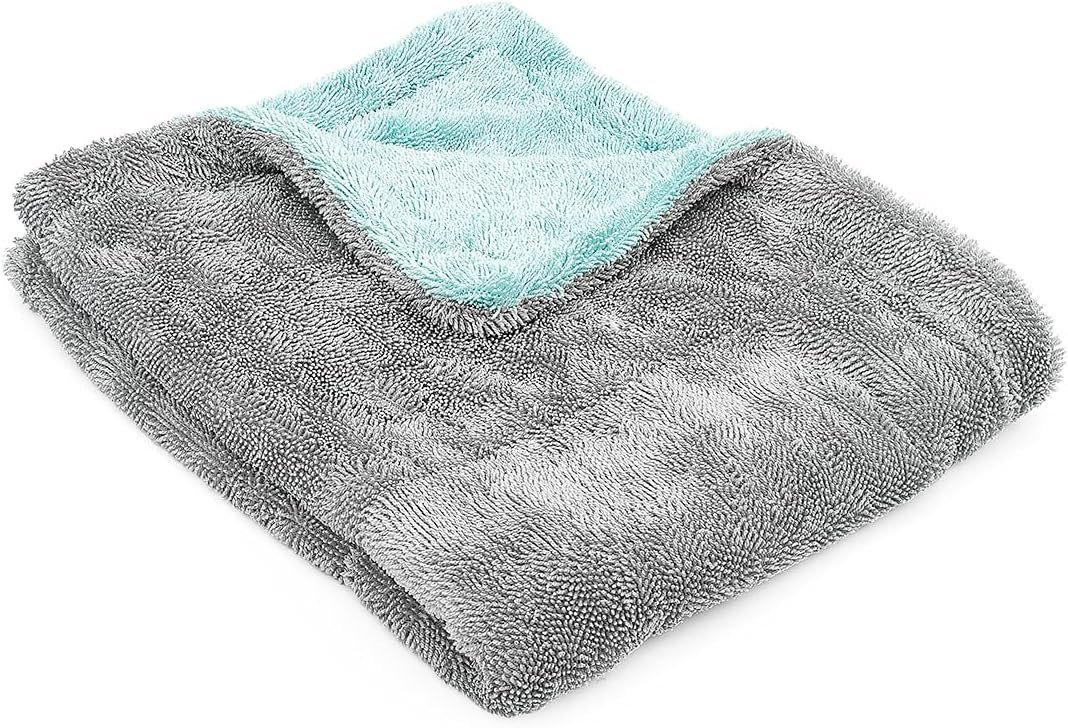
Twisted Loop Drying Towels
-
Extremely absorbent, ideal for drying an entire car quickly.
-
High GSM, typically around 800 to 1400 GSM.
-
Around $25 to $40 per towel
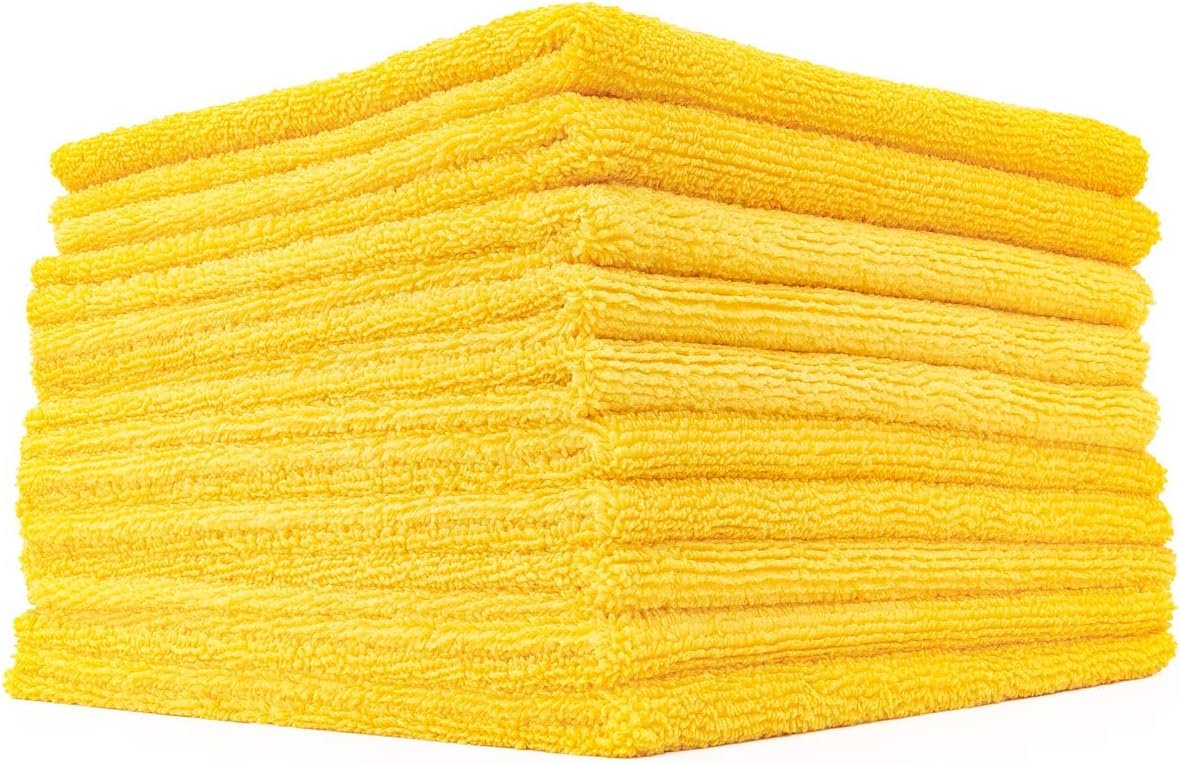
Edgeless Towels
-
Description text goes here
-
Description text goes here
-
Description text goes here
Microfiber Applicator Pads

-
For applying waxes, sealants, or conditioners evenly.
-
Not typically measured in GSM, as they are more sponge-like.
-
Often sold in packs, ranging from $1 to $3 per pad.
Why Microfiber Towel Choice Matters More in San Diego
San Diego's climate looks ideal — 70 degrees, endless sun, almost no rain. For car paint, it's one of the more demanding environments in the country.
UV intensity. Over 260 sunny days per year means clear coat absorbs UV radiation constantly. UV-stressed clear coat is thinner, more brittle, and more vulnerable to micro-scratches from friction. A towel that would be perfectly safe on a car garaged in Portland will show swirl marks faster on a car that lives outdoors in Chula Vista or Clairemont.
Marine air and salt deposits. The coastal strip from La Jolla through Ocean Beach down to Coronado gets persistent salt air. Salt particles settle on paint between washes and bond to the surface. A microfiber car cloth dragged across a salt-contaminated panel acts like low-grit sandpaper on clear coat. Our standard practice on every coastal job is a panel rinse before any towel makes contact — regardless of how clean the car looks.
Hard water. San Diego's water is notoriously mineral-heavy. Water spots from hard water etch into clear coat faster than most people expect, especially on dark paint in direct sun. A high-GSM drying towel that removes water in one or two passes rather than three or four dramatically reduces the window for minerals to bond. In San Diego, your drying towel isn't a convenience purchase — it's paint protection.
Inland valley dust. In areas like El Cajon, Santee, Lakeside, and Escondido, dry Santa Ana wind events push fine particulate east across the county. Never wipe a dry, dusty car with any towel, microfiber or otherwise. But when you do move to drying and wiping after a wash, a high-pile twisted loop format minimizes the number of passes and the total time the towel is in contact with the surface.
The takeaway for San Diego owners: the minimum acceptable GSM for a drying towel here is 600. On dark paint, ceramic coatings, or fresh paint correction work, go to 1,000+. The climate makes the difference between an adequate towel and a good towel more meaningful than it would be elsewhere.
Best Microfiber Towels for Car Detailing 2026
The Rag Company - All-Purpose Microfiber Terry Cleaning Towels
Use: Ideal for delicate tasks like polishing and buffing surfaces without scratching.
The Rag Company - Standard Waffle Weave Towels
Use: Best suited for windows due to their high absorbency and less streaking capabilities.
The Rag Company - Edgeless 365 Microfiber Towels
Use: Perfect for final-touch detailing and buffing, especially where avoiding scratches is crucial.
The Rag Company - Dual-Pile Plush 420 Dark Pack
Use: Versatile with a plush side for waterless washing or quick detailing, and a shorter nap side for removing waxes or sealants.
The Rag Company -Twist Loop, 1100gsm,Microfiber Drying Towel
Use: Extremely absorbent, ideal for quickly drying an entire car.
Sukh Microfiber Rectangle Sponge Detailing Pads
Use: Not a towel, but essential for evenly applying waxes, sealants, or conditioners without scratching.
What Makes Microfiber Towels Different from Traditional Towels?
1. Fiber Construction
Microfiber towels are made from tiny fibers that trap dirt and debris, unlike traditional towels, which can spread particles around and cause scratches.
2. GSM Rating
Higher GSM towels (600–1500) are more absorbent and better suited for drying and detailing, while lower GSM towels (300–500) work well for cleaning and wiping.
3. Specialized Designs
Options like waffle weave, terry weave, and edgeless designs cater to specific tasks, from drying to ceramic coating application.
The right towel can significantly improve the drying process, ensuring a scratch-free and spotless finish. While some users may use a drying aid to enhance drying performance, top-quality towels are effective even without it. Additionally, using a detail spray with microfiber towels is popular for buffing and finishing, further enhancing surface maintenance and appearance.
The 5 Best Microfiber Towels for Car Detailing in 2026 Review
These are the detailing microfiber towels our team at Fresh Layer carries on every job. We've tested these across hundreds of vehicles in San Diego — everything from base-coat Civics to ceramic-coated Teslas and freshly painted show cars.
1. Best Overall: Rag Company Edgeless 365
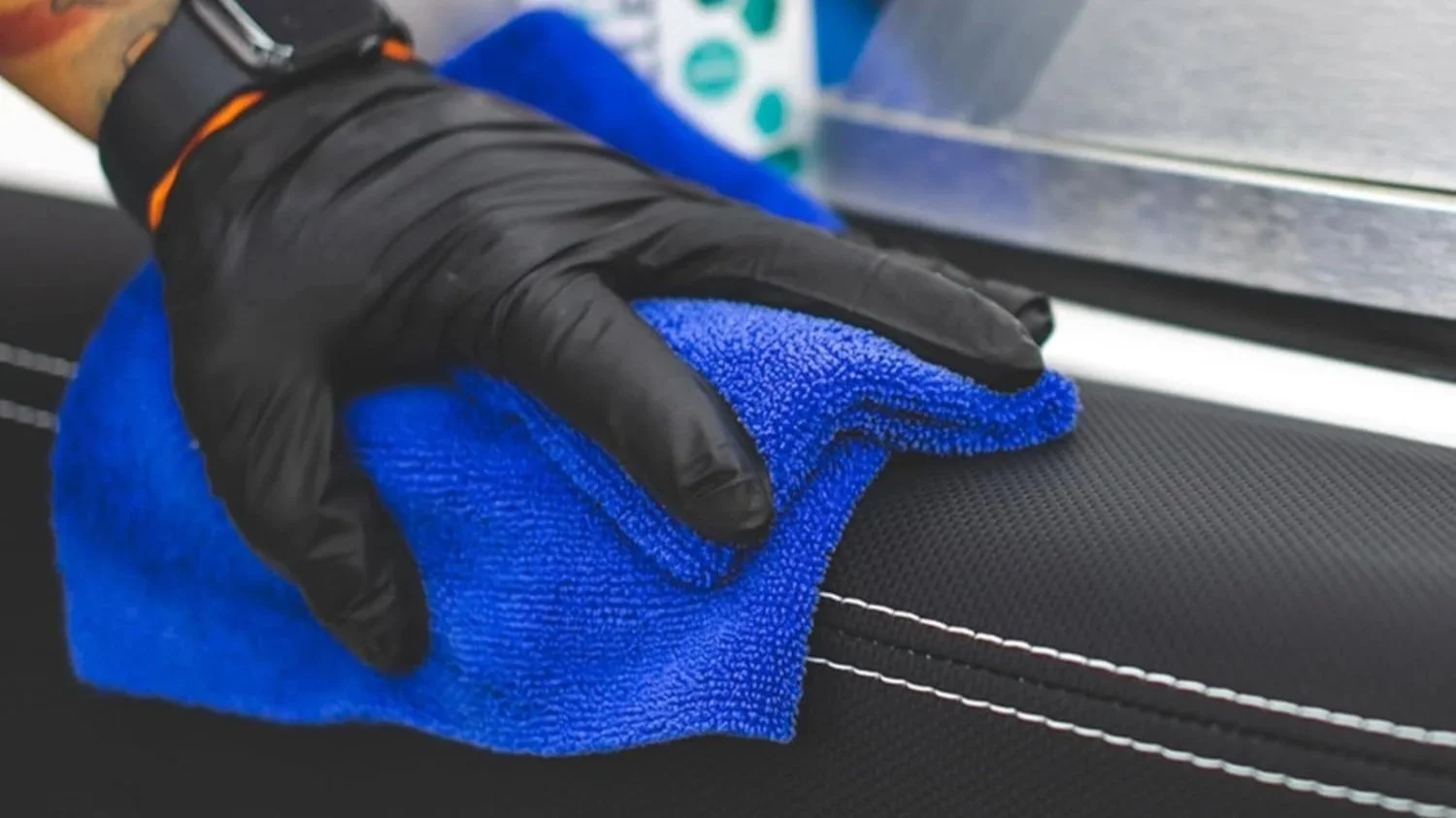
GSM: 365 | Blend: 70/30 polyester/polyamide | Edge: Edgeless
The Edgeless 365 is the towel that lives in a detailer's hand from the start of a job to the last buff. Over 600,000 fibers per square inch. Soft enough for clear coat, structured enough to pull wax and sealant residue cleanly off a panel without dragging.
The 70/30 blend is the right call for paint — enough polyamide to stay soft under pressure, enough polyester to maintain structure as the towel picks up product. The edgeless construction means no stitched border anywhere near your clear coat.
What it handles well: All detailing sprays, no-rinse wash products, wax removal, sealant buffing, finishing polish cleanup, quick detail spray application and buff.
What it doesn't do: Drying. The 365 GSM is not designed to move large volumes of water efficiently. Use it after the car is dry — not instead of a proper drying towel.
Care note: Wash separately from high-GSM drying towels. Lint from a 1,100 GSM twisted loop towel will transfer to an edgeless 365 in the wash and reduce its effectiveness on glass and painted surfaces.
2. Best Car Drying Towel: Rag Company Twist Loop 1100 GSM
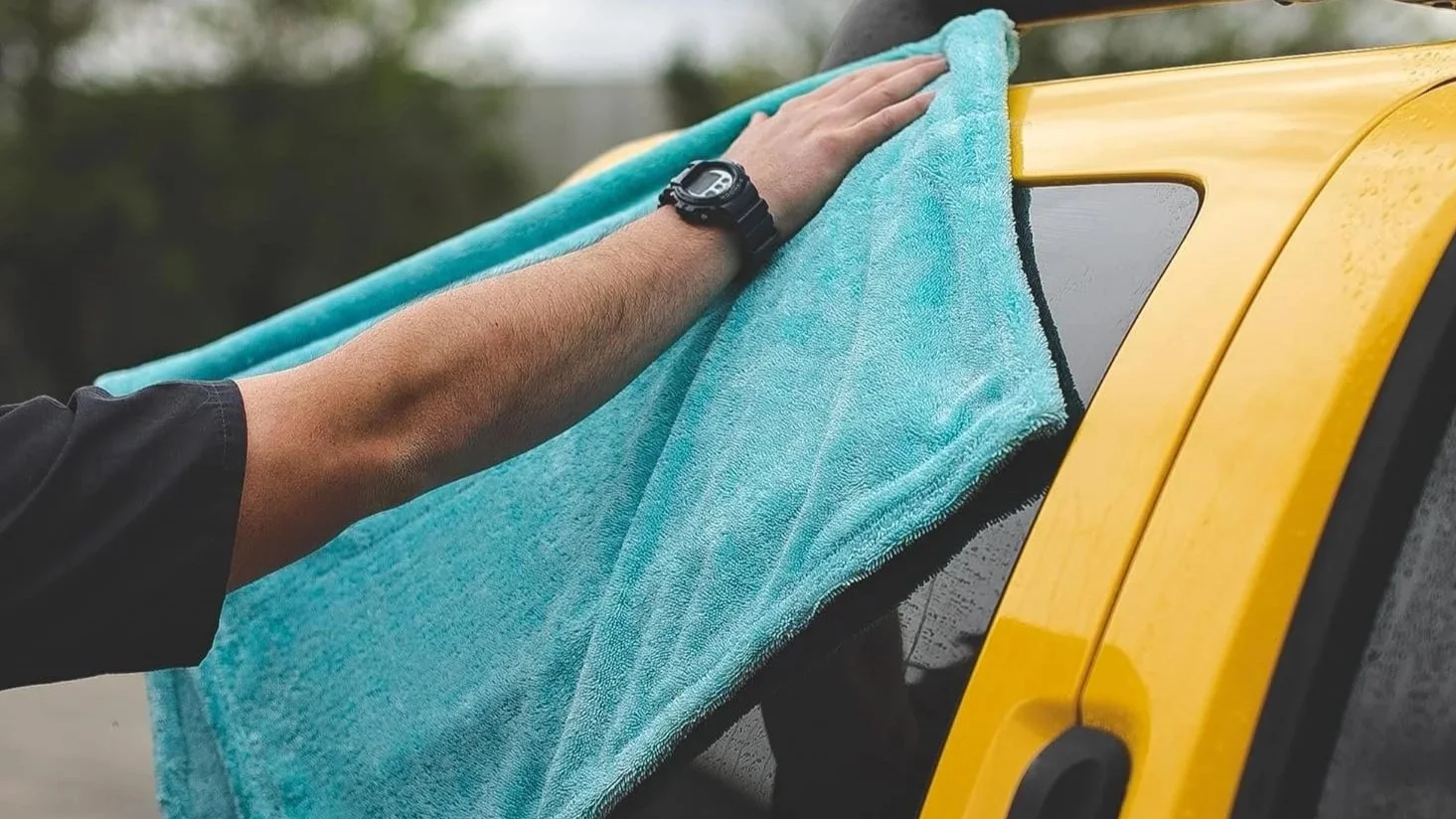
GSM: 1,100 | Best for: Full-panel drying, post-rinse, ceramic-coated vehicles
If water spots are a concern — and in San Diego they always are — this is the towel. The twisted loop construction compresses fiber density into a format that absorbs more water per pass than any flat-weave or waffle design at the same GSM. A single 25"x36" version can dry a full-size sedan or SUV without becoming saturated.
The 1,100 GSM means the towel's base fabric stays a significant distance from your paint during drying. That cushion of fiber is what makes this the safest drying towel on the market for vehicles with paint correction work, ceramic coatings, or single-stage paint that can't take another round of machine polishing.
Technique note: Blot, don't wipe. Press the towel against the panel and lift — don't drag across. Dragging a drying towel, even a premium one, across a panel that still has microscopic particles in the water moves those particles. Blotting lifts the water and the particles into the towel.
For dark cars and black cars specifically: The 1,100 GSM Twist Loop is not optional. Dark paint — black, deep grey, dark navy — shows swirl marks from improper drying at a much finer level than light paint. The pile height advantage of this towel at 1,100 GSM is exactly what prevents those marks from forming.
3. Best for Waxing and Polish Removal: Rag Company Dual-Pile Plush 420 Dark Pack
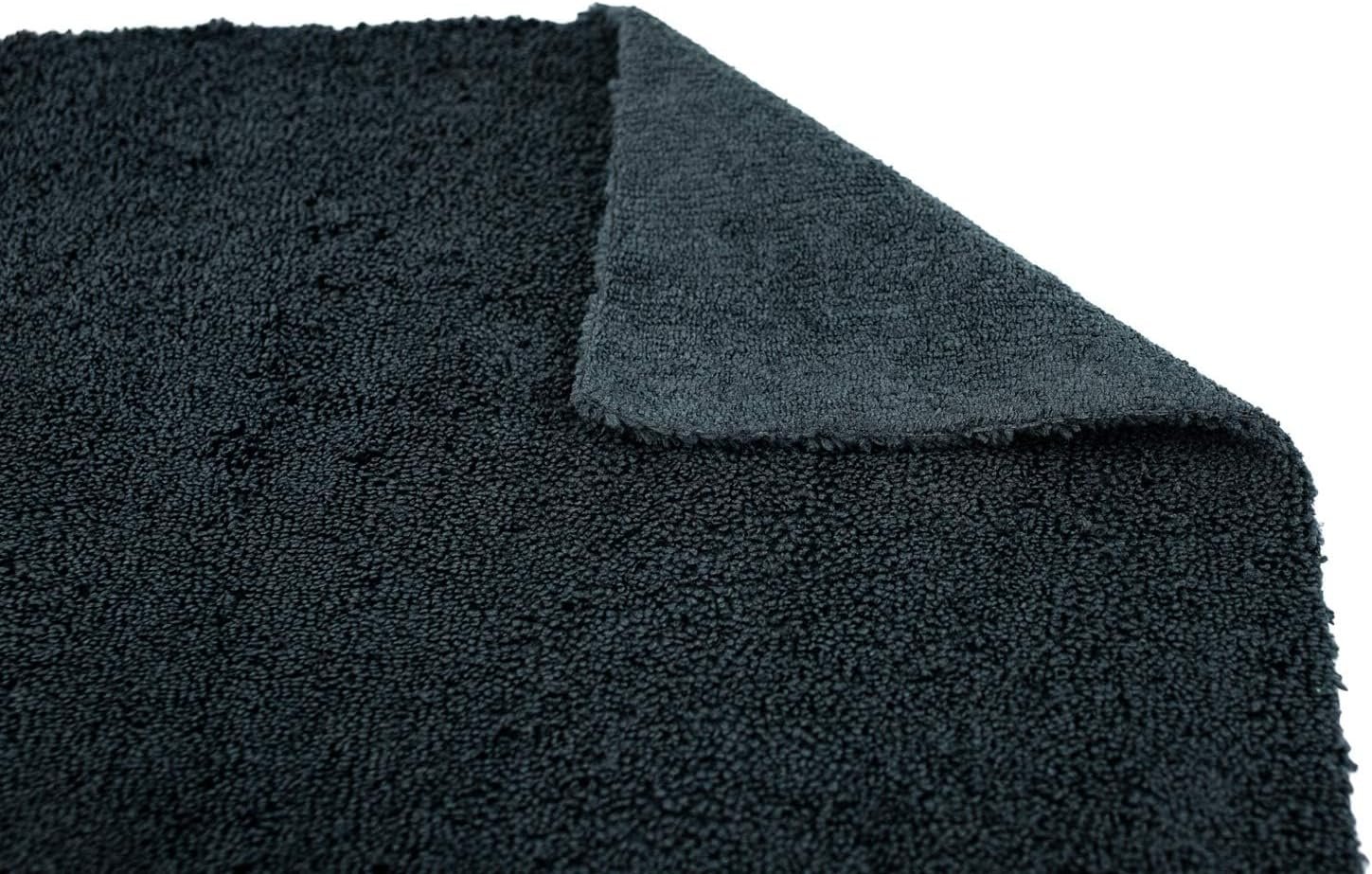
GSM: 420 | Blend: 70/30 | Feature: Two distinct pile heights on opposite sides
The dual-pile design gives you two functional surfaces in one towel. The plush, high-pile side is for application — detailing spray, waterless wash, light-coat spray wax. The shorter-nap side is purpose-designed for removal — pulling wax residue, sealant film, or glaze haze off the panel without leaving lint or streaking.
This towel earns its place in the paint correction process. After a compound or finishing polish pass, the short-nap side removes residue cleanly without the towel loading up with product and smearing it back onto the surface.
The dark color pack serves a real purpose: you can see exactly how much product you're pulling off at each pass. When the towel face shows color change from the paint protection product you're removing, you know it's time to flip to a fresh quadrant or replace the towel.
Pro tip: Fold the towel into four equal squares and work one quadrant at a time. Sixteen passes across a panel before you need a fresh towel — at which point you switch, not reuse.
4. Best Microfiber Towel for Car Windows and Glass: Rag Company Standard Waffle Weave
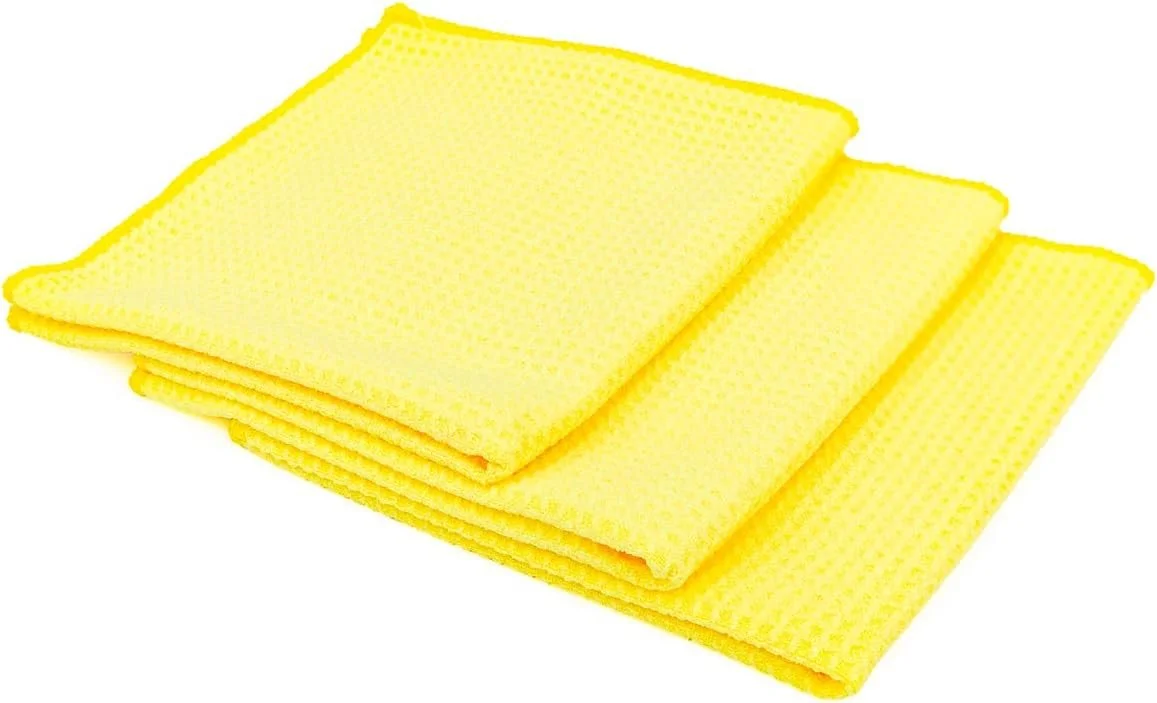
GSM: Lightweight (waffle-specific construction) | Blend: 70/30 | Feature: Textured grid pattern
The waffle weave is the engineering solution to glass cleaning. The grid pattern increases the towel's effective surface area — each cell in the grid acts as a mini-reservoir that channels glass cleaner residue and water away from the surface as you wipe. The result is streak-free, lint-free glass in fewer passes than any other towel type.
For windows, lint-free is non-negotiable. A terry towel on glass will leave micro-fiber deposits that catch light and create haze. A waffle weave leaves nothing behind.
Use a slightly damp waffle weave towel for the cleaning pass, then a dry one for the final streak check. On interior glass — which tends to accumulate silicone vapor from dash protectants — a second dry pass with a fresh waffle weave section removes the film that causes interior windshield haze.
Strict use rule: Keep waffle weave towels for glass only. One pass on a freshly waxed panel deposits enough product into the towel to compromise its performance on glass for the rest of the session.
5. Best Microfiber Towel for Ceramic Coating Work: Rag Company All-Purpose Terry
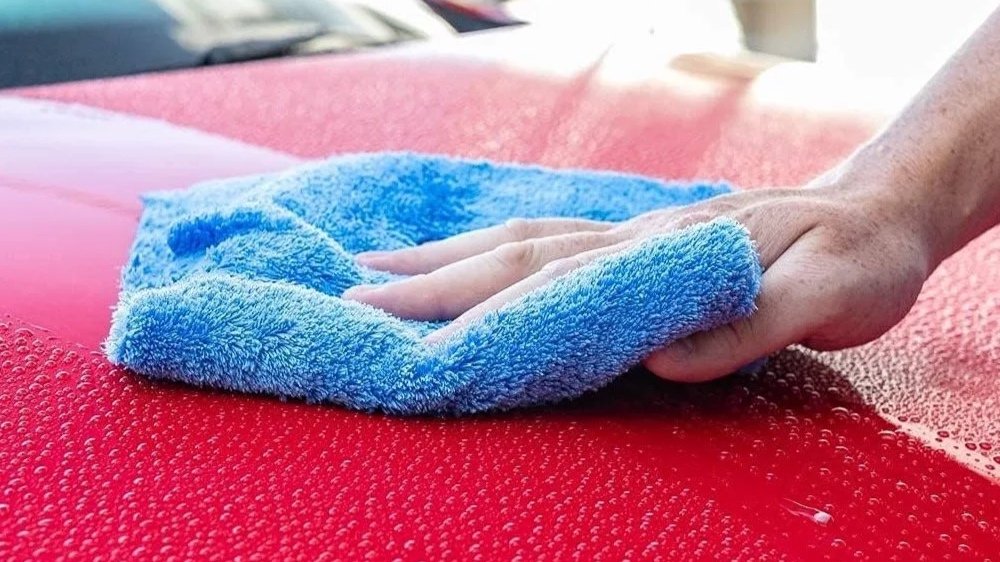
GSM: 365 | Blend: 80/20 | Feature: 200,000+ fibers per square inch
Ceramic coating application is a specialized task and requires a specialized approach to microfiber. During the application window — when the coating is still in its flash-off phase — you need a towel that picks up excess product quickly without dragging or redepositing. The all-purpose terry's 80/20 blend and looped construction do this efficiently.
Keep these towels strictly dedicated to ceramic coating work. Contamination from wax, oil, or silicone-based product will compromise how the coating bonds to the panel during application. Fresh from the wash, handled with clean gloves.
Two-towel rule for coating application: Use one towel for the initial wipe of the flash-off product. Use a second, completely fresh towel for the final buff. Reusing the first towel redeposits concentrated product into the low spots of the panel — exactly where you don't want it.
Best Microfiber Towel for Drying Cars Without Scratching
The drying step causes more paint damage than washing, polishing, and waxing combined. The reason: people treat a drying towel like a kitchen towel. They drag it across the panel, don't fold it, use it saturated, and never consider whether a dirty car should even be dried with a towel before being rinsed properly.
Here's how to dry a car without scratching the paint:
Step 1 — Rinse properly first. A thorough rinse removes the bulk of surface contamination before your towel makes contact. Skipping this step and going straight to drying is the leading cause of wash-induced scratches.
Step 2 — Use the right drying towel. Minimum 600 GSM, twisted loop construction, 70/30 blend. For dark paint or ceramic-coated vehicles, 1,100 GSM. No exceptions.
Step 3 — Blot, don't wipe. Press the towel flat against the panel and lift straight off. Don't drag it sideways. Dragging a damp towel across a panel moves any remaining particles laterally across your clear coat. Blotting lifts them straight up and into the towel.
Step 4 — Fold into quarters. Work one quadrant of the towel at a time. Flip to a fresh face as each quadrant saturates. A folded 25"x36" towel gives you eight usable faces before the towel is truly spent.
Step 5 — Start at the top, work down. Water on the lower panels carries more road contamination. Starting at the roof and working down means you're using the freshest towel faces on the cleanest surfaces.
Step 6 — Never reuse a towel that's been dropped. Once a drying towel hits the ground, it's done for paint work. The grit it picks up from asphalt or concrete will scratch on the next pass regardless of how good the towel was before it fell.
For San Diego owners specifically, drying speed matters because mineral-laden water spots faster in direct sun. On a clear San Diego afternoon, you have under two minutes on a black car before water starts to spot. A high-GSM drying towel that finishes the job in fewer passes is doing real paint protection work.
In a world of car detailing, we discover the best way how to wash microfiber towels
Best Microfiber Towels for Polishing and Wax Removal
Polishing and wax removal are where people most often grab the wrong towel — and where getting it wrong is most visible.
For applying polish or compound, you're typically using a machine polisher with a pad. The microfiber towel enters the picture for removing the residue after the pad does its work. For this, you want a 350–500 GSM edgeless towel in 70/30 blend. The goal is clean pickup — pulling the compound or polish residue off the panel without smearing it across adjacent sections.
The dual-pile 420 GSM towel is ideal here because the short-nap side picks up heavy residue without the long-pile fibers getting so loaded with product that they start redistributing rather than removing.
For carnauba wax application and removal, a slightly different approach applies. Application should go on thin — thin enough that you can almost see through it on the panel. For application, a 350 GSM terry or edgeless towel spreads product evenly. For removal once the wax hazes, a 400–500 GSM edgeless with 70/30 blend pulls the wax cleanly without marring the finish underneath.
For spray sealants and paint protection spray, a 70/30 edgeless towel in the 350–400 GSM range works for both application and removal. Work in small sections — two square feet at a time — flipping to a fresh towel face regularly. Sealant that starts to dry before removal loads the towel with hardened product that then drags across the panel.
Polishing cloth tip: Never use a polishing cloth on glass or interior trim in the same session before washing it. Polish residue in the towel fibers will haze glass and leave silicone deposits on interior plastics that are difficult to remove without a dedicated cleaner.
Best Microfiber Towels for Black Cars and Dark Paint
Black and dark-colored vehicles are where microfiber quality makes the biggest visible difference. Swirl marks from improper towel use on black paint catch light at every angle — what looks invisible on silver becomes a spider web of fine scratches on midnight black.
For dark cars, apply the following standards across the board:
Drying: 1,100 GSM twisted loop, blotting technique, mandatory. A 600 GSM towel is fine for light paint. On black, it's not worth the risk.
Polish removal: 70/30 edgeless only. No overlocked edges near the paint.
Detailing spray buff: Edgeless 365 or equivalent. Work in small sections in indirect light so you can see any streaking or swirl formation as you go.
Quick detail between washes: Waterless wash products paired with a 70/30 edgeless towel on a black car should always include a pre-wipe inspection — run your fingers over the panel first. If you feel grit, a quick detail spray is not safe. The car needs a rinse.
Post-correction protection: After a paint correction on a black car, the paint is as defect-free as it's going to get. Every subsequent contact matters. We apply ceramic coating after correction on dark vehicles specifically because the coating adds a sacrificial layer that takes the friction of everyday cleaning rather than the paint itself.
Best Microfiber Towels for Hand Washing Your Car
Hand washing is still the safest wash method when done correctly — and the towels (or wash mitts) you use make or break the result.
For hand washing, a microfiber wash mitt is the right tool for the initial wash pass, not a towel. A two-bucket method — one bucket of clean soapy water, one bucket of plain rinse water — combined with a plush microfiber wash mitt minimizes the risk of trapping grit in the wash media and dragging it across the paint.
After washing, the drying process follows the same rules outlined above: 600–1,100 GSM twisted loop, blot technique, top-down.
Where towels come into hand washing is the detail work: door jambs, badges, trim lines, and wheel wells where a mitt can't reach cleanly. For these areas, a 300–400 GSM terry towel dampened with wash solution works well — the pile holds enough soap to clean the surface, and the GSM is low enough to give you control in tight spaces.
For waterless car wash, the standard approach is different. Waterless wash works by lubricating the surface heavily with a high-surfactant formula so a microfiber towel can slide across without dragging dry particles. For waterless wash, you need a dedicated 70/30 edgeless towel in the 350–500 GSM range. Fold into quarters. One panel per towel face — never reuse a face on a new panel. For an average four-door sedan, you'll use six to eight fresh towel faces for a complete waterless wash.
One rule that applies to all hand washing: Never wash your microfiber towels with regular laundry. The lint, fabric softener residue, and synthetic fiber fragments from regular clothes will work into your microfiber's split fibers and reduce their cleaning ability permanently.
Microfiber Towel Care: How to Wash Detailing Towels So They Last
Even the best car detailing microfiber towels become scratch hazards if they're washed wrong. This section covers everything — because most swirl-mark problems aren't from the wrong towel, they're from a good towel that's been ruined by a bad wash.
Before First Use
Wash new microfiber towels before using them on paint. Manufacturing processes leave residue, loose fibers, and treatment coatings on new towels that can reduce absorbency on first use and occasionally leave fine particles that scratch.
Separate Every Time
Never wash microfiber towels with regular laundry. Cotton lint from t-shirts and jeans embeds in the split fibers and turns a clean microfiber into a lint-distributing cloth. Also separate:
Interior towels from exterior towels. Exterior towels carry brake dust, iron particles, road grime, and paint overspray. These contaminants will transfer to interior towels in the wash.
High-GSM from low-GSM. Twisted loop drying towels shed fibers during washing that can embed in thinner edgeless towels and compromise their performance on glass.
Dark from light. Standard color separation applies — dye transfer is real, especially on first few washes.
The Detergent Rule
Use a microfiber-safe, fragrance-free, softener-free liquid detergent. Many detailers use a dedicated microfiber detergent. If you're using a standard laundry detergent, check the label: if it lists a fabric softener, fragrance, or optical brightener, don't use it on microfiber.
Never use fabric softener. This is the single most common cause of degraded microfiber performance. Fabric softener coats the split fibers with a waxy film that fills the gaps that give microfiber its cleaning power. A towel washed once with fabric softener loses a measurable percentage of its absorbency — and it doesn't come back. The only solution is replacement.
No dryer sheets for the same reason.
Temperature and Drying
Wash in warm water (90–105°F). Hot water — above 140°F — degrades the polyamide in the fiber over time and reduces softness.
Tumble dry on low heat or air dry flat. High heat melts polyester fibers. A towel dried on high heat repeatedly loses its split-fiber construction — it looks fine and feels soft but performs like a cheap cotton cloth.
When to Replace
Replace a microfiber towel when:
It feels scratchy or stiff after washing
It leaves lint on glass or dark surfaces
It stops absorbing water quickly
It smells despite repeated washing (oil contamination, usually from engine work or heavy compound)
A quality drying towel used properly should last 200+ wash cycles. A budget towel treated poorly can degrade in under ten.
FAQs About Microfiber Towels
-
A clean, quality microfiber towel won't scratch car paint. The risk comes from dirty towels — grit trapped in the fibers acts like sandpaper on clear coat. Always use separate towels for each task, wash them after each use without fabric softener, and never reuse a towel that's been dropped. A 70/30 polyester/polyamide edgeless towel is the safest choice for painted surfaces. The "microfiber scratches paint" reputation almost always traces back to contaminated towels, cotton-blend microfiber, or dragging technique — not quality microfiber used correctly.
-
It depends on the task. For drying, use 600–1,100+ GSM to maximize water absorption and pile height. For wax and polish removal, 350–500 GSM balances absorbency with maneuverability. For interior surfaces and glass, 200–400 GSM gives you precision. Don't try to use one GSM for everything — a 1,100 GSM drying towel on a dashboard is clumsy; a 300 GSM cloth as your drying towel means too many passes and too much surface contact.
-
The ratio describes polyester to polyamide (nylon) content. An 80/20 blend is stiffer and more durable — better for interior scrubbing, general cleaning, and ceramic coating buffing where you want the towel to hold its shape. A 70/30 blend has more polyamide, making it noticeably softer and more absorbent — the right choice for anything touching paint or glass. Most professional detailing towels use 70/30 for painted surface work.
-
No. Exterior towels pick up brake dust, iron particles, and road grime that will scratch interior leather, vinyl, and trim. Interior towels carry conditioner and protectant residue you don't want anywhere near clear coat. Use dedicated towels for each area, color-code them (blue exterior, yellow interior is a common system), and wash them in separate loads.
-
A waffle weave towel in 70/30 blend, kept exclusively for glass work. The waffle pattern channels glass cleaner residue away from the surface rather than smearing it, and its lint-free construction leaves glass clear. For streak-free results: one slightly damp waffle weave pass to clean, one dry waffle weave pass to finish. Keep glass towels away from wax, polish, or protectant products.
-
Warm water (not hot), microfiber-safe detergent with no fabric softener or fragrances, washed separately from all other laundry. Never add fabric softener or dryer sheets — both permanently degrade the split-fiber construction. Tumble dry on low heat or air dry. Separate interior from exterior towels, and high-GSM from low-GSM towels in each wash load. A quality towel washed correctly should last 200 wash cycles.
-
For drying a black car, use a 1,100 GSM twisted loop towel and blot rather than wipe. For polish removal, use a 70/30 edgeless towel in the 365–420 GSM range. For quick detailing spray, the Edgeless 365 is the right choice. Black paint shows swirl marks at a finer level than light paint, so the margin for error is smaller — higher GSM, blotting technique, and no overlocked edges touching the paint are all non-negotiable.
-
Not if it's clean, the right type, and used correctly. Dirty microfiber absolutely can scratch paint — grit, brake dust, and road debris embedded in fibers act as abrasives on clear coat. The solution is washing towels after each use, using dedicated towels per task, and blotting rather than wiping during the drying step. A 70/30 edgeless microfiber towel used on a clean, rinsed panel will not scratch the paint.
How Fresh Layer Selects and Uses Microfiber on Every San Diego Job
At Fresh Layer Mobile Detailing, towels aren't an afterthought — they're part of the system. Every van carries separate labeled bags: drying, paint, interior, glass, and coating towels. Each bag gets washed separately after every job.
Here's how towel selection changes by service:
Basic wash: Rag Company Twist Loop 1100 GSM for drying after the rinse. Edgeless 365s for any spray-and-buff follow-up. Waffle weave for glass. Every panel blotted, not wiped.
Interior detailing: 300–400 GSM flat-weave cloths for dashboards and hard surfaces. 70/30 350 GSM for leather. Waffle weave for interior glass. Interior and exterior towels never touch the same surface in the same session.
Paint correction: After machine polishing passes, dual-pile 420 GSM removes compound and polish residue. Edgeless 365 for the final surface wipe before inspection. After paint correction work in San Diego, we inspect under LED lighting before touching the surface with anything — including a towel.
Ceramic coating: Fresh, wash-only towels straight from the bag. Gloves worn during handling. One towel for the flash wipe, a second towel for the final buff. No reuse of any towel that's touched a coated panel. Our ceramic coating services start at $599 and we treat the towel protocol at that price point the same way we'd treat surgical prep. The coating is only as good as the panel it bonds to.
Full detail: Every service category above, in sequence. Full detail pricing starts at $349.
If you want to know exactly which products and towels we use on your vehicle before booking, call us — we'll tell you.
Book Mobile Detailing in San Diego
Fresh Layer comes to you anywhere in San Diego County — your driveway, your parking garage, your office. Call (619) 874-4115 or book a mobile detailing appointment to get started. From a basic wash to a full ceramic coating, we bring the right tools for every job — including the towels.