


Automatic Car Washes vs Mobile Detailing: Pros, Cons & Best Choice for San Diego
Your Quick Answer
Bottom line: If you commute I-5 or I-805 and park near the coast, mobile detailing is the safer long-term choice for paint and interior health. Automatic washes work for quick exterior rinses between proper details, but repeated tunnel wash use creates swirl marks that eventually need professional correction.
Who should choose what:
Automatic wash: Fast rinse between details, removing light dust
Touchless wash: Safest automatic option if you must use one (but stronger chemicals)
Mobile detailing: Paint protection, interior health, quarterly deep cleaning
| Option | Best For | Biggest Risk | Real Result |
|---|---|---|---|
| Automatic wash | Fast exterior rinse | Swirls + harsh chemicals | "Looks clean" from 10 feet |
| Mobile detailing | Paint + interior reset | Higher upfront cost | Real protection + comfort |
What we see weekly: Swirl patterns from tunnel washes on black paint and soft clear coats—especially on Teslas, BMWs, and Japanese vehicles with softer factory paint.
This guide shows you exactly what each option does to your paint, what it costs over time, and which makes sense for your San Diego driving situation.
Why This Decision Matters More in San Diego (2025 Reality Check)
San Diego isn't Phoenix (dry heat only) or Seattle (just rain). We have a specific combination of environmental factors that makes your car washing choice more important.
Coastal "Marine Layer + Sun Bake" Cycle
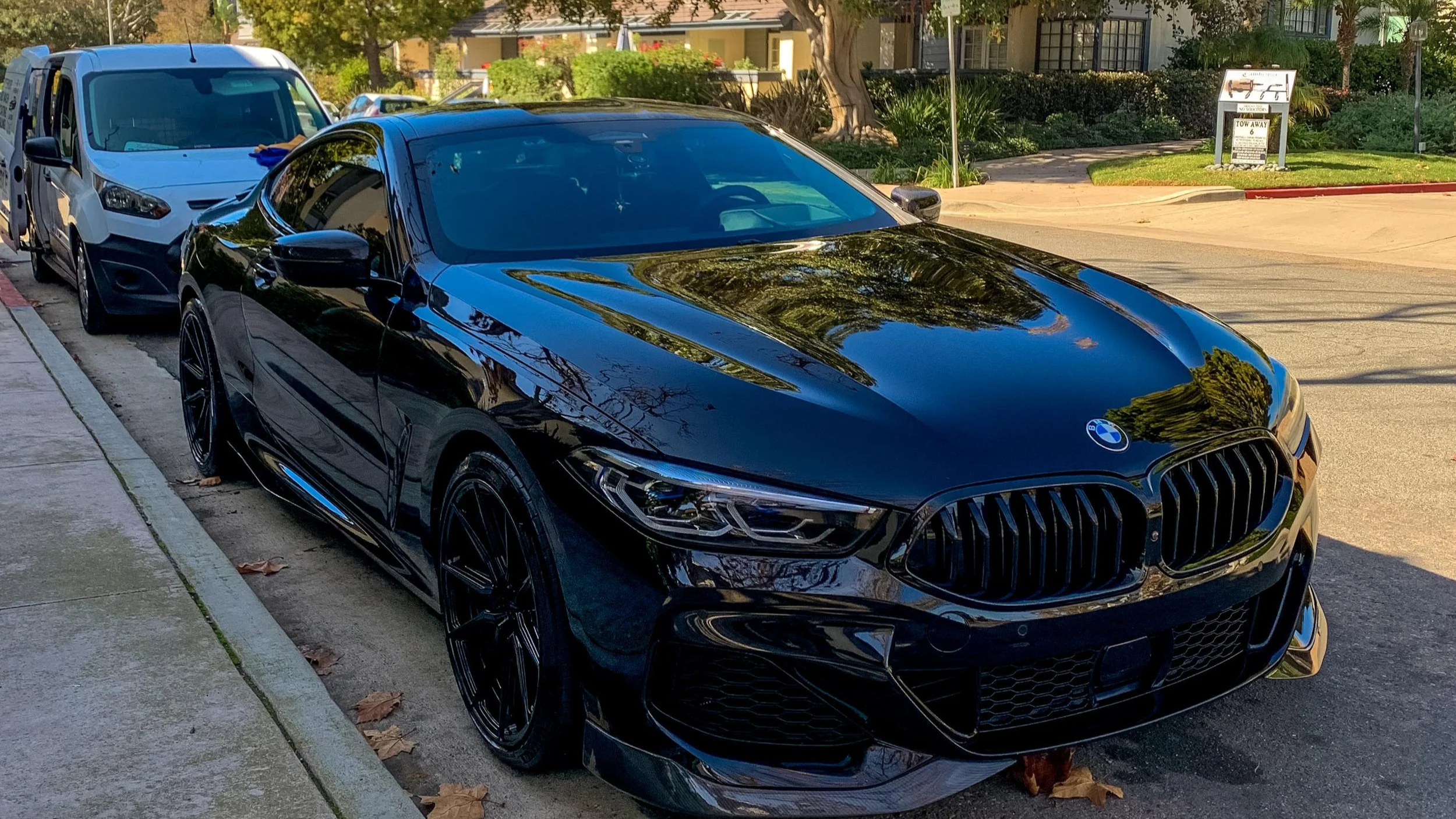
If you park in Pacific Beach, La Jolla, Del Mar, or Coronado:
Every night, marine layer settles—that gray fog carrying salt particles from ocean waves. Moisture condenses on your paint. When morning sun burns off the fog, water evaporates but salt stays, bonding with your clear coat.
Now imagine running that salt-covered paint through tunnel wash brushes. You're essentially scrubbing salt particles across your clear coat like sandpaper. The damage compounds weekly.
We see the results constantly: 2-3 year old coastal vehicles with visible swirl marks, even though owners wash regularly. The combination of salt contamination + automated brushes creates accelerated paint damage.
Inland Heat + Hard Water Spot Etching
East County residents (La Mesa, El Cajon, Santee) face different problems:
San Diego water contains 250-300 PPM dissolved minerals. When automatic washes spray this hard water and don't dry properly, mineral deposits dry on your paint. In 95-100°F inland heat, these minerals etch into clear coat within hours.
Irrigation overspray from sprinklers adds to the problem. The minerals bond at a molecular level—they don't wash off. They require either chemical treatment or machine polishing to remove.
The Compliance Angle Most People Miss (Runoff Rules)
Important legal fact: Uncontrolled wash water entering storm drains is illegal in San Diego County. City ordinances prohibit allowing soapy water to run from your property into streets or storm drains—penalties can reach $10,000 per day per incident.
This matters because:
Home driveway washing (without containment) violates stormwater rules
Commercial car washes must recycle and treat water
Professional mobile detailers use water reclamation systems or minimal water methods
According to San Diego County's stormwater management guidelines, wash water must either be contained or directed to sanitary sewer (not storm drains). This puts proper mobile detailing on the right side of environmental and legal compliance.
Automatic Car Wash Types Explained (And Which Does the Most Damage)
Not all automatic washes damage paint equally. Understanding the differences helps you make better choices.
Soft-Touch Brush Tunnels
How they work: Rotating foam or cloth strips scrub your vehicle as you drive through. Water and soap are applied simultaneously.
The problem: Those brushes trap contaminants from previous vehicles—sand, brake dust, road grit. Even "soft" brushes create friction while dragging this contamination across your paint.
What "spiderweb" scratches look like: Circular patterns visible in direct sunlight, especially on black, dark blue, or dark gray paint. These are micro-scratches in your clear coat from brushes moving in circular patterns while contaminants are trapped in the material.
According to the International Detailing Association's 2024 research, 78% of vehicles develop visible swirl marks within 12 months of regular soft-touch car wash use.
San Diego context: Beach sand and salt particles in coastal areas make this worse. That fine sand trapped in brushes is essentially polishing compound—it's abrading your clear coat every wash.
Touchless Automatic Washes
How they work: High-pressure water jets and strong chemicals clean without physical contact. No brushes or cloth touch your paint.
Pros: Safest automatic option—no physical contact means no scratches from contaminated brushes.
Cons: To compensate for no friction, touchless washes use stronger alkaline chemicals (pH 11-13). These can strip wax and sealants faster than hand washing. They also don't remove bonded contaminants like tar, tree sap, or industrial fallout—they only remove loose dirt.
What they miss: Interior gets zero attention. Drying is minimal, leading to water spots. Wheels and wheel wells often stay dirty.
Recycled Water and Why It Matters in Sand + Mineral Areas
Many automatic washes recycle water to conserve resources. While environmentally good, recycled wash water contains suspended particles—sand, brake dust, minerals—from previous vehicles.
When that contaminated water hits your paint with high pressure, those suspended particles create additional abrasion. It's like washing your car with water that has tiny bits of sandpaper floating in it.
San Diego reality: Our combination of beach sand (coastal) and hard water minerals (everywhere) means recycled wash water is more abrasive here than in areas with soft water and no coastal sand exposure.
Mobile Detailing Explained (What You Actually Get vs "Car Wash Clean")
Let's be clear about what mobile detailing actually provides versus a $15 automatic wash.
Exterior Process (Safe Wash System)
Step 1: Pre-rinse (5 minutes) High-pressure rinse removes loose dirt and sand before any contact. This prevents scrubbing contaminants across paint during washing.
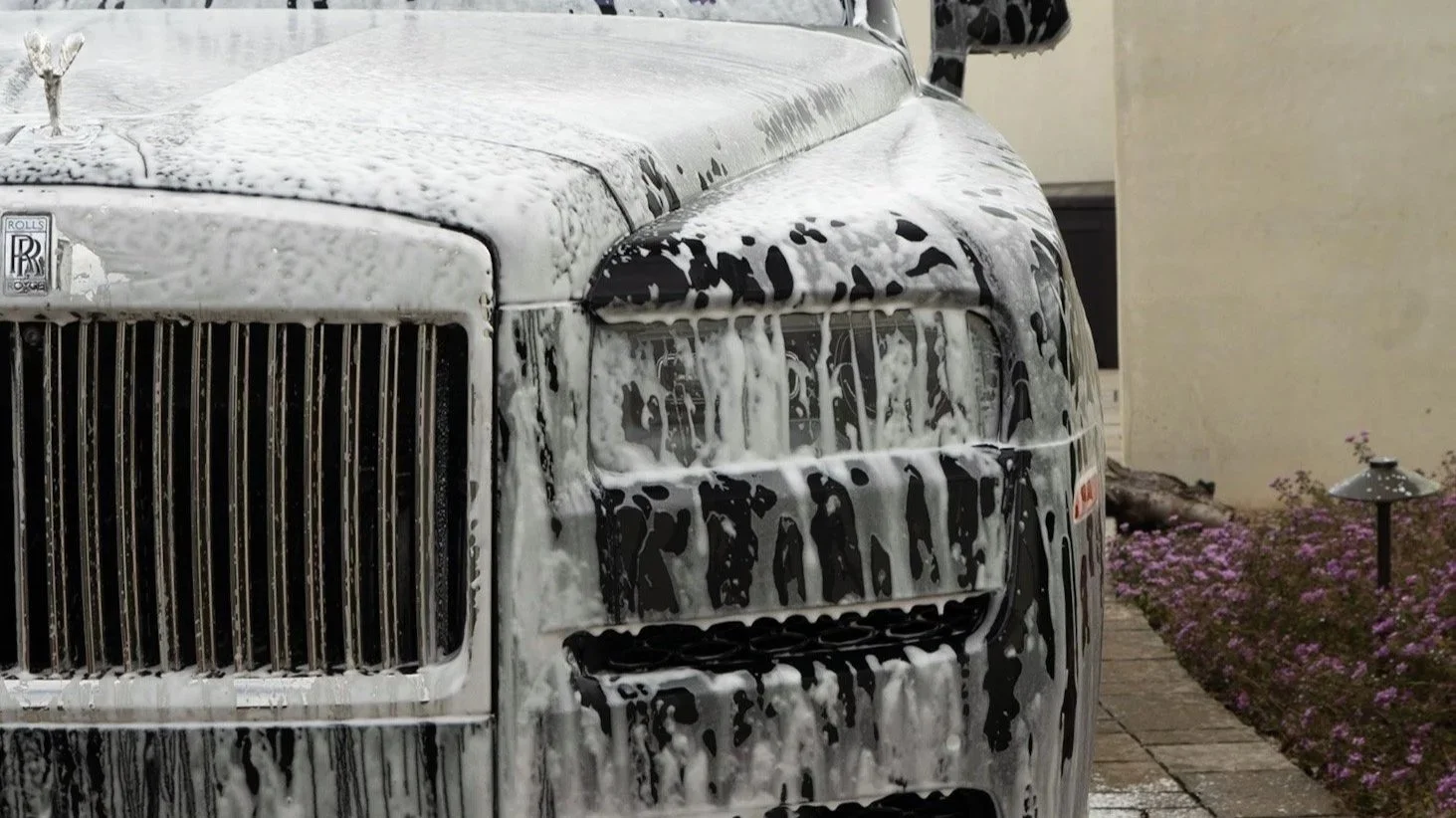
Step 2: Foam application (5 minutes) pH-neutral snow foam sits on paint, loosening bonded contamination chemically rather than mechanically.
Step 3: Two-bucket hand wash (20-30 minutes) Clean water bucket for rinsing wash mitt between panels. Soap bucket for washing. This prevents contamination buildup on the mitt.
Step 4: Safe drying (10 minutes) Clean microfiber drying towels prevent water spots and don't create scratches.
Optional add-ons:
Iron decontamination spray (removes embedded brake dust)
Clay bar treatment (removes bonded contamination)
Wax or ceramic coating application (protection layer)
The key difference: Every step designed to avoid paint damage. No recycled water with contaminants. No brushes trapping sand. Just clean materials and proper technique.
Interior Is the Real Difference
This is where automatic washes offer literally nothing and mobile detailing provides the most value.
What gets cleaned:
Dashboard wiped and dressed (UV protection prevents cracking)
Center console detailed (cup holders, gear shift, buttons)
Door jambs and handles cleaned
Steering wheel sanitized (most bacteria-laden surface in vehicle)
Seats vacuumed and treated (fabric cleaned, leather conditioned)
Floor mats and carpets deep cleaned
Air vents blown out
Windows cleaned inside and out
Why this matters in San Diego:
Beach sand grinds into carpet and seats
Salt air leaves sticky residue on surfaces
Hard water spots on windows (exterior automatic washes miss interiors)
Pet hair removal (automatic washes don't touch this)
Interior Health Angle
According to a 2023 study by The Drive, the average steering wheel contains 700% more bacteria than a typical toilet seat. Your interior is where you sit daily, breathing the air, touching surfaces with your hands.
Mobile detailing includes sanitization of high-touch surfaces—steering wheel, door handles, center console—something automatic washes completely ignore.
For families with kids: Regular interior cleaning reduces allergens, dust, and bacteria that affect air quality in enclosed vehicle space.
The Hidden Cost Calculator (Why "Cheap Washes" Get Expensive)
Let's do honest math on what each option costs over a year.
| Scenario | Visits/Year | Cash Cost | Paint Risk | Total Real Cost |
|---|---|---|---|---|
| Automatic wash ($15) | 26 (bi-weekly) | $390 | Swirls → eventual correction needed | $390 + $600-$1,200 correction |
| Mobile maintenance ($150) | 4 (quarterly) | $600 | Minimal risk with proper care | ~$600 |
| Hybrid approach | 8 details + 16 rinses | $1,200 + $240 | Best of both | ~$1,440 |
Important clarification: Not every tunnel wash guarantees $2,000 in damage. But if you care about your vehicle's finish, repeated soft-touch tunnel washes often lead to paid paint correction within 2-3 years.
Paint correction (machine polishing to remove swirl marks) costs $600-$1,200 depending on severity. If you're using tunnel washes weekly for 3 years, you'll likely need this service. When you factor in correction cost, the "cheap" automatic washes become expensive.
Luxury and dark-colored vehicles: The timeline accelerates. Black BMWs, dark blue Teslas, and midnight silver Audis show swirls within 6-12 months of regular tunnel wash use.
Comparing Automatic Car Washes and Mobile Detailing
Let's break down the key differences:
| Factor | Automatic Car Wash | Mobile Detailing |
|---|---|---|
| Cleanliness | Surface-level clean | Deep, thorough clean |
| Time | Quick (5-10 minutes) | Longer (2-4 hours) |
| Convenience | Drive-through service | At-home service |
| Cost | $10-$20 per wash | $100-$300+ per detail |
| Long-term Effects | Potential paint damage | Paint protection and preservation |
Time = Money (The 2025 Convenience Argument San Diegans Actually Buy)
The "automatic washes are faster" argument needs honest examination.
The Real Cost of a 'Quick' Car Wash
Automatic wash time breakdown:
Drive time to car wash: 10-15 minutes
Wait in line: 5-20 minutes (weekends worse)
Wash cycle: 5-7 minutes
Drying/spot removal time: 5-10 minutes
Drive home: 10-15 minutes
Total: 35-70 minutes
Multiply that by 26 visits per year: 15-30 hours annually spent on car washing logistics.
Mobile detailing time breakdown:
Scheduling online: 2 minutes
Detailer arrives at your location: 0 minutes (you stay home/work)
Service time: 2-4 hours (you're not present)
Your actual time invested: 2 minutes per detail
Multiply that by 4 quarterly details: 8 minutes annually.
"Zoom Call Detail" (Work-From-Home Reality)
As San Diego mobile detailers who've completed over 1,000 services since 2018, we've found remote workers are our fastest-growing customer segment. They schedule details during work hours, stay on Zoom calls inside, and have a clean car by lunch.
Common San Diego work zones we serve during business hours:
Mission Valley office buildings
Sorrento Valley tech corridor
Miramar business parks
UTC / La Jolla commercial areas
Downtown San Diego high-rises
For parents: Schedule mobile detailing during school hours. Car is clean when you pick up kids. No weekend time lost driving to car washes.
Water Use and San Diego Rules (The Local "Moat" Section)
Water regulations in San Diego make mobile detailing more practical than most people realize.
Water-Use Restrictions (Hose Shut-Off Nozzle Rule)
Per City of San Diego Municipal Code Section 147.04, you must use a hose with a positive shut-off nozzle when washing vehicles. Water cannot continuously flow. This is actively enforced during drought periods with fines up to $500 per violation.
Practically speaking: You can wash at home if you follow the rules, but most people don't have proper containment systems for runoff.
Stormwater Runoff: Why It's a Big Deal
San Diego County Code of Ordinances prohibits allowing wash water to leave your property and enter storm drains. This includes:
Soap running down your driveway to the street
Rinse water flowing to curb drains
Any wash water entering storm drainage system
Why it matters: Storm drains lead directly to San Diego Bay, Mission Bay, and the Pacific Ocean—no treatment. Soap, oils, heavy metals from brake dust, and chemicals go straight to marine habitats.
Penalties: Up to $10,000 per day per violation under the Clean Water Act
For coastal communities: This is especially critical. Pacific Beach, Ocean Beach, La Jolla, and Del Mar have active enforcement due to proximity to protected marine areas.
How Professional Mobile Detailing Is Done Responsibly
Professional mobile detailers use water reclamation systems that capture, filter, and properly dispose of wash water. Some use waterless or minimal-water washing methods (2-5 gallons vs. 40-80 gallons for automatic washes).
Fresh Layer's approach: We either use reclamation mats that capture all water for proper disposal, or we direct wash water to sanitary sewers (not storm drains) where properties allow. Full compliance with San Diego County stormwater regulations.
According to EPA WaterSense data, professional mobile detailing using water-saving techniques uses 85-90% less water than traditional automatic car washes.
Best Choice by San Diego Driver Type (Your Decision Engine)

Your ideal approach depends on where you live, what you drive, and how you use your vehicle.
If You Commute Freeways Daily (I-5 / I-805 / SR-52 / SR-163)
Your reality: Rock chips, road grime, brake dust, freeway film building up constantly.
Best approach:
Quarterly mobile detailing ($150-$200 each)
Monthly touchless rinse for loose dirt ($15-$20)
Annual paint protection film on hood/bumper (prevents rock chip damage)
Why: Freeways create constant contamination that bonds to paint. Professional decontamination every 3 months prevents buildup. Monthly rinses between details handle surface dirt.
If You Live Near the Coast (Pacific Beach, Ocean Beach, La Jolla, Del Mar)
Your reality: Salt air, marine layer moisture, sand everywhere.
Best approach:
Monthly or bi-monthly mobile detailing ($100-$150)
Weekly rinse at home with hose + proper soap (following city rules)
Quarterly interior deep clean (sand removal from carpets/seats)
Annual ceramic coating refresh
Why: Salt accelerates paint damage. Regular professional cleaning prevents salt etching. Interior focus removes abrasive beach sand that grinds into carpet.
If You Lease
Your reality: End-of-lease inspection checking for excessive wear, interior stains, exterior damage.
Best approach:
Quarterly mobile detailing throughout lease
Paint correction 3 months before lease return
Final detail before return inspection
Why: Lease return charges for interior stains, swirl marks, and excessive wear can hit $500-$1,500. Quarterly detailing prevents damage that triggers charges. Final correction and detail ensure you pass inspection clean.
If You Drive a Dark Color or Black Car
Your reality: Every swirl mark, water spot, and scratch is instantly visible.
Best approach:
Never use soft-touch tunnel washes
Touchless automatic only if absolutely necessary
Mobile detailing every 6-8 weeks minimum
Annual paint correction to remove swirls
Ceramic coating for protection
Why: Dark paint shows every imperfection. One tunnel wash creates visible damage. Mobile detailing with proper technique is the only way to maintain that mirror finish black cars are known for.
FAQs (Everything You're Actually Wondering)
-
Soft-touch tunnel washes with brushes create micro-scratches (swirl marks) on most vehicles, especially those with soft clear coat or dark paint. The brushes trap sand, brake dust, and contaminants from previous cars, which then scratch your paint during washing. Touchless automatic washes are safer since nothing physically touches your paint, but they use stronger chemicals to compensate.
After detailing 1,000+ San Diego vehicles, we see swirl patterns from tunnel washes constantly—particularly on black Teslas, BMWs with soft paint, and any dark-colored vehicle.
-
Yes, touchless is significantly safer for your paint since nothing physically contacts your clear coat. However, touchless washes use stronger alkaline chemicals (pH 11-13) to compensate for no mechanical scrubbing. These chemicals can strip wax and sealants faster than pH-neutral hand washing.
Touchless also can't remove bonded contamination—tar, tree sap, industrial fallout. It only handles loose dirt. For paint safety, touchless is best automatic option, but professional hand washing is still superior.
-
Coastal residents: Every 4-6 weeks due to salt air and marine layer damage Inland residents: Every 6-8 weeks due to UV exposure and hard water Freeway commuters: Every 6-8 weeks due to road grime and debris Garage-kept weekend cars: Every 3-4 months
San Diego's combination of salt air (coast), intense UV (inland), and hard water (everywhere) accelerates paint degradation 30-40% faster than temperate climates. More frequent professional care prevents damage that costs more to repair later.
-
Those circular scratches (swirl marks) come from tunnel wash brushes dragging contaminated materials across your clear coat. Each brush pass creates microscopic scratches. Over multiple washes, these accumulate into visible patterns—especially noticeable in direct sunlight on dark paint.
The contamination can be sand from previous vehicles, brake dust, or even dried soap residue in the brush material. Even "soft" brushes create friction while moving these particles across your paint.
-
Yes, if the property allows it. We've detailed hundreds of vehicles at San Diego apartment complexes. Requirements: dedicated parking space for 3-4 hours, property management approval (we provide insurance certificates), and either access to electrical outlet or permission for generator use.
We bring everything needed—water, equipment, supplies. Most apartment communities welcome professional services as long as we follow their guidelines and don't disrupt other residents.
Why San Diego Drivers Choose Fresh Layer Mobile Detailing
What We Do Differently
Safe wash process: Two-bucket method, pH-neutral soaps, clean microfiber towels every service. No shortcuts, no contaminated materials touching your paint.
Interior-first mindset: We see detailing as primarily about where you sit daily—steering wheel bacteria, dashboard dust, seat stains, floor sand. Exterior shine is important, but interior health affects you every drive.
Consistent process: Same high standards whether you drive a 2010 Camry or 2024 Porsche. Every vehicle gets complete service—no rushed jobs, no missed areas.
San Diego expertise: 1,000+ local services since 2018. We understand coastal salt damage, inland heat stress, and hard water challenges specific to San Diego County.
What Customers Say
"We park blocks from the beach in Pacific Beach. Fresh Layer removes all that sand from our carpets and the salt film from exterior. Tunnel washes never touched the interior. Worth every penny." - Mike T., Pacific Beach
"I work from home in Mission Valley. They detailed my car during a Zoom meeting. When I walked out at lunch, it looked brand new. Didn't waste any of my weekend." - Sarah L., Mission Valley
"After one year of tunnel washes, my black Tesla had visible swirl marks. Fresh Layer corrected the paint and now handles all washing. The difference is night and day." - David R., Del Mar
Our Approach to Great Service
Brian Dean, founder of Backlinko, says: "You really have to create legitimately great content and a legitimately great website to rank in Google." Same applies to detailing—real process beats shortcuts every time.
We don't cut corners. We don't rush. We do complete work that actually protects your vehicle rather than just making it "look clean" from 10 feet away.
Book Mobile Detailing in San Diego
Stop paying for tunnel washes that damage your paint and ignore your interior. Get real protection and cleanliness with professional mobile detailing—at your home or office while you work or relax.
We service all of San Diego County:
Coastal: Pacific Beach, La Jolla, Del Mar, Coronado, Ocean Beach
Central: Mission Valley, Hillcrest, North Park, Kearny Mesa
North County: Encinitas, Carlsbad, San Marcos, Oceanside
East County: La Mesa, El Cajon, Santee, Poway
Mobile detailing services:
Exterior hand wash + protection: $100-$150
Complete interior detail: $150-$200
Full mobile detail (interior + exterior): $200-$300
Paint correction + ceramic coating: $800-$1,400
This month's special: First-time customers save $50 on complete detail packages.
100% satisfaction guaranteed: If you're not thrilled with results, we re-do the work or refund completely. In 6 years and 1,000+ services, we've had fewer than 10 dissatisfied customers—all resolved same-day.