What Is Paint Correction? 2026 Guide: Process, Benefits & Why It Matters in San Diego
Paint correction is a multi-stage machine polishing process that removes defects from your car's clear coat: swirl marks, oxidation, water spot etching, and light scratches. It works by leveling the paint surface so light reflects evenly again. It doesn't cover damage. It removes it.
At Fresh Layer Mobile Detailing, it's one of the most requested services we do across San Diego County, especially before ceramic coating applications where the prep work determines how long the coating actually lasts.
If your paint looks dull, hazy, or full of tiny swirls that catch the light at every angle, paint correction is probably what you need, not a wax job, not a polish, not a detail spray. This guide breaks down exactly what it is, what it fixes, what it doesn't, and what it costs in San Diego.
Quick Answer: What Is Paint Correction?
What it is: Machine polishing that removes clear coat defects, not covers them
What it fixes: Swirl marks, oxidation, water spot etching, light scratches, haze, paint transfer scuffs
What it can't fix: Scratches your fingernail catches in, clear coat that's peeling or flaking, chips down to primer or metal
Typical results: 50-95%+ defect removal depending on how many stages are needed
Why it matters more in San Diego: UV index 10+ in summer, coastal salt air, and hard water all accelerate clear coat breakdown faster than most California cities
Text or email us photos if you want to know which stage your car actually needs.
What Is Paint Correction?
Your car's paint is made up of layers. The clear coat sits on top and is the layer that takes all the visible damage: swirl marks from automatic car washes, water spot etching from mineral-heavy tap water left to bake in the sun, haze from UV exposure, and fine scratches from improper washing.
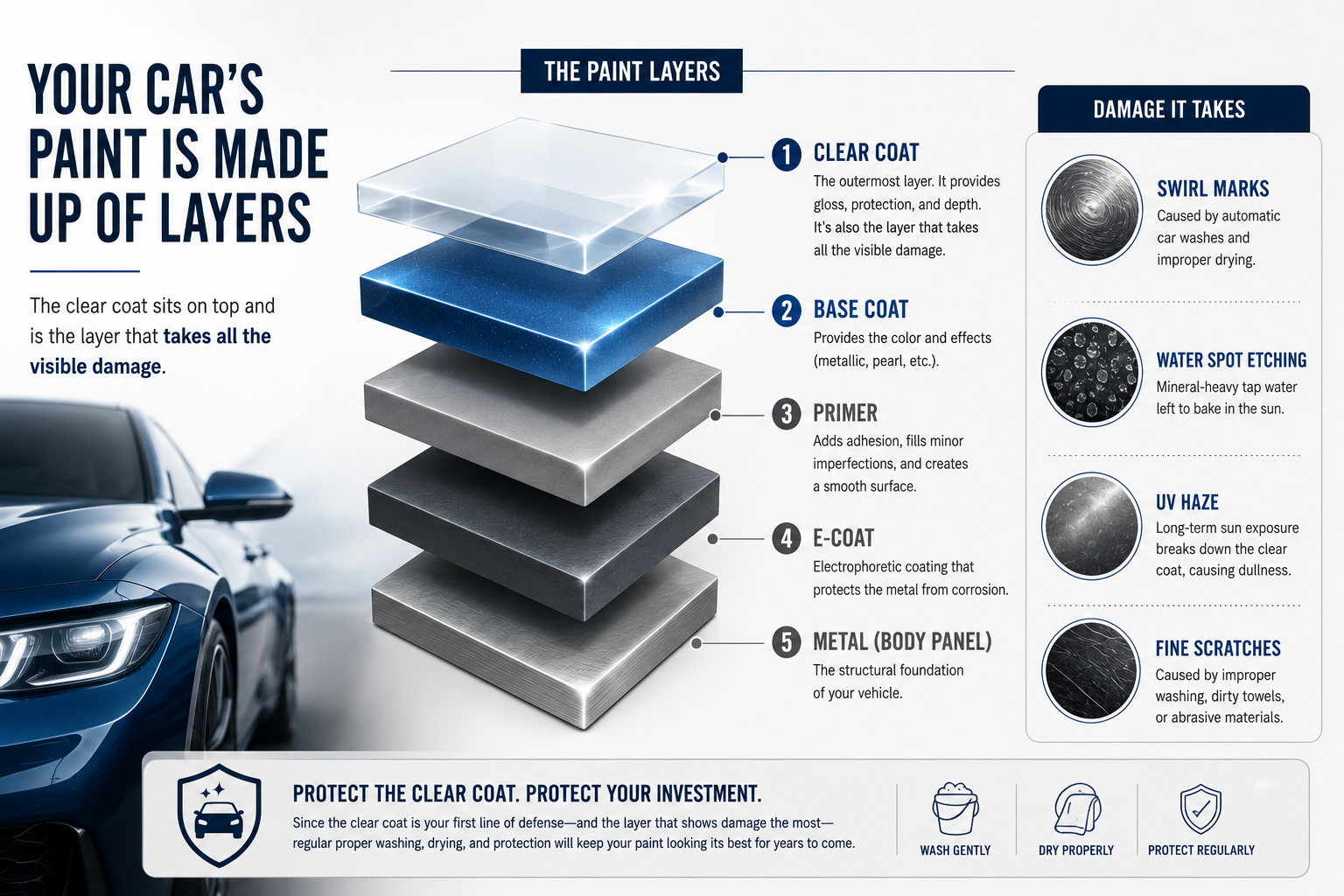
Paint correction removes a controlled, microscopic amount of that clear coat using machine polishers and a sequence of compounds and polishes.
The goal is to level the surface so that light reflects off it cleanly and evenly, what detailers call "paint clarity." When light scatters off uneven peaks and valleys in the clear coat, you see swirls and haze. When the surface is level, you see depth and gloss.
This is completely different from wax, glaze, or paint sealant, which fill defects temporarily rather than removing them. It's also different from basic polishing, which uses milder products and removes less material. True paint correction means multi-stage machine work calibrated to your specific paint type and defect level.
Our paint correction service in San Diego starts with a paint thickness measurement before we touch anything, so we always know exactly how much clear coat is available to work with.
What Does Paint Correction Remove?
Swirl marks and wash marring These are the most common defects we see on San Diego cars. Fine circular scratches caused by automatic car washes, drive-through wash brushes, and even improper hand washing. On dark colors, they're visible from 10 feet away. Paint correction removes them by leveling the surrounding clear coat.
Light scratches (clear coat level) Scratches that sit within the clear coat layer can be polished out. Quick test: run your fingernail across the scratch. If your nail glides over it without catching, it's in the clear coat and correction will remove or significantly reduce it. If your nail drops into the scratch, it goes deeper.
Oxidation and haze UV-baked paint loses its clarity over time. The clear coat becomes chalky and dull. This is extremely common on San Diego vehicles that park outdoors, especially on the roof, hood, and trunk lid where sun exposure is most intense. Correction removes the damaged outer layer and restores the gloss underneath.
Water spot etching Hard water leaves mineral deposits when it dries. In San Diego, tap water runs around 300 ppm of dissolved minerals. When water spots dry on a hot panel. common after a morning rinse in Pacific Beach or Chula Vista, the minerals bond to and etch into the clear coat. Light spots are polishable. Severe etching may need wet sanding.
Paint transfer and scuffs Paint rubbed onto your car from another vehicle, a shopping cart, or a parking garage pillar often sits on top of your clear coat rather than in it. Correction removes the transferred material and levels any remaining marks.
What Paint Correction Can't Fix
Deep scratches your fingernail catches (those need touch-up paint, not polishing)
Clear coat failure, when the coating is peeling or flaking off entirely
Chips that go down to primer or bare metal
Orange peel texture (the factory "dimpled" look on some OEM paint jobs), correction can reduce it slightly, but eliminating it entirely requires wet sanding, which isn't always appropriate
| Metric | Overview |
|---|---|
| Cost Range | Varies from basic touch-ups ($150) to luxury-level corrections ($1,500+) |
| Customer Satisfaction | 80%+ of customers report high satisfaction with paint correction services |
| Popularity | Frequently sought after as part of a full detailing package |
| Value | Paint correction adds significant value by restoring vehicle aesthetics |
The Paint Correction Process, Step by Step
This is what a professional paint correction actually looks like on your car:
Thorough decontamination wash: removes loose dirt, brake dust, and road film before any contact with the paint
Iron decontamination spray: chemical decon dissolves embedded iron particles (brake dust, rail dust) that a wash won't remove and that will tear up a polishing pad
Clay bar treatment (as needed): pulls bonded contaminants out of the clear coat surface
Tape and protect trim: rubber, plastic trim, and emblems are masked to prevent compound from staining them
Paint inspection under high-intensity LED lighting: this is where we map every defect and measure paint depth with a paint thickness gauge across all panels
Test spot: we run a test section first to select the right compound and pad combination for your specific paint hardness and defect level
Machine polishing: using Rupes dual-action polishers, we work panel by panel. The number of stages depends on defect severity (more on this below)
Panel wipe and re-inspection: each panel is wiped with an IPA solution to remove polishing oils so we can see the true corrected result under the light
Protection: corrected paint must be sealed. Options include paint sealant, ceramic coating, or paint protection film
The whole paint correction process typically runs 4-8 hours for a standard vehicle, longer for trucks, SUVs, or heavily defected paint.
How Many Stages of Paint Correction Do You Need?
Single-Stage Correction (Polish)
Typical defect removal: 50-80%
Uses one step, a finishing polish or light compound, and is the right call for daily drivers with light swirl marks, mild haze, or soft wash scratches. It's not the most aggressive correction, but for a car with relatively clean paint that just needs to look sharp again, it's usually enough. Faster and lower-cost than multi-stage.
Two-Stage Correction (Compound + Polish)
Typical defect removal: 80-95%+
The most common professional option. Step one uses a cutting compound to remove heavier defects. Step two uses a finishing polish to refine the surface and bring out full gloss. Dark colors, vehicles with automatic car wash history, or anything with moderate-to-heavy swirl marks usually needs two-stage work.
Three-Stage or Wet Sanding
Typical defect removal: 95%+
Reserved for severe cases, deep marring, heavy oxidation, severe water etching, or show car prep where every last scratch needs to come out. Wet sanding is controlled, but it removes more clear coat, so paint thickness measurements are critical before going this route.
One thing worth being straight about: no detailer can promise 100% defect removal on every car without risking the clear coat. The goal is always maximum correction within safe paint depth limits.
Paint Correction vs Polishing vs Wax vs Repainting
| Method | Removes defects? | Risk level | Lasts how long | Best use case |
|---|---|---|---|---|
| Wax or sealant | No, fills temporarily | Low | 3-6 months | Light gloss maintenance |
| Glaze/filler products | No, masks temporarily | None | Weeks | Pre-sale gloss boost |
| Basic polish | Minimal | Low | N/A | Light haze removal |
| True paint correction | Yes, permanently | Medium (requires skill) | Until next damage | Defect removal, coating prep |
| Repaint | Yes, replaces panel | Low (if quality shop) | Years | Damage too deep to correct |
Wax is worth using after correction to protect the result. Using wax instead of correction just makes a swirl-marked car look slightly shinier while the swirls stay underneath.
Why San Diego Makes Paint Correction More Urgent
San Diego is harder on car paint than most cities, and this isn't marketing language. Here's what's actually happening to your clear coat.
UV and Heat
San Diego's UV index regularly hits 10-11 in summer, with June through September being the hardest months. UV breaks down clear coat chemistry over time, causing oxidation and haze. especially on horizontal panels like hoods, roofs, and trunk lids that face the sun directly. Inland San Diego (El Cajon, Santee, Poway, Rancho Bernardo) sees more intense heat than the coast, which accelerates this even further.
Coastal Salt and Marine Layer
If you park within a few miles of the ocean, La Jolla, Pacific Beach, Point Loma, Coronado, Ocean Beach, the marine layer cycles through your car every night. Salt-laden moisture settles on every surface, then dries out during the day. That cycle deposits salt film that etches into paint and promotes micro-scratching during your next wash. The salt also attacks emblems, window trim, and unprotected paint edges over time.
Hard Water and Water Spot Etching
San Diego's municipal water supply runs around 300 ppm dissolved minerals, which is on the harder side. When hard water dries on hot paint, like after a morning rinse that you let air dry in the driveway, the mineral deposits stay behind and bond to the clear coat. Left long enough in San Diego sun, they etch into the paint and create Type II water spots that can't be removed with a regular wash. They need paint correction.
This combination of UV, salt, and mineral water means San Diego vehicles accumulate paint defects faster than cars in lower-UV, lower-humidity, softer-water cities.
Do You Need Paint Correction Before Ceramic Coating?
Almost always, yes. Here's the logic: ceramic coating bonds directly to your clear coat surface and locks in whatever condition the paint is in at the time of application. It doesn't fix defects, it seals them permanently.
Swirl marks and scratches under a ceramic coating actually look sharper, not better, because the high-gloss ceramic amplifies the visual contrast of every surface irregularity. You spent money on protection that's now highlighting your paint problems.
Paint correction before ceramic coating ensures the coating bonds to a clean, defect-free surface, that the gloss it produces is actually gloss (not hazy gloss), and that the full coating lifespan is achievable because the prep was done right.
Skipping correction to save money on a coating job usually leads to one of two outcomes: you live with the defects locked under the coating, or you have the coating removed later to correct the paint, which costs more than doing it right the first time.
How Much Does Paint Correction Cost in San Diego?
Paint correction pricing depends on vehicle size, paint condition, and how many stages the defects require. Pricing also varies by whether you're adding protection afterward.
General San Diego ranges:
| Stage | Sedan | SUV / Truck | Time |
|---|---|---|---|
| Single-stage | Lower end | Mid range | 4-5 hours |
| Two-stage | Mid range | Higher end | 6-8 hours |
| Three-stage / prep for coating | Higher end | Top of range | 8-12 hours |
Adding a full detail package before or after correction is common and can be bundled.
What changes the price: paint condition when we arrive, vehicle size, paint hardness (harder factory paints take more time), and the protection applied afterward. A quick quote before we come out is always the right call. We'll ask you to send us photos of your paint in natural light so we can give you an accurate estimate rather than a guess.
Call us at (619) 874-4115 or text photos for a straight answer on what stage you need and what it will cost.
Why Fresh Layer for Paint Correction in San Diego
Fresh Layer Mobile Detailing is IDA-certified and Gtechniq-certified, and we bring the full setup to you, your driveway, your office parking spot, wherever your car lives. We've corrected paint on everything from weekend track cars in Chula Vista to leased SUVs in Carmel Valley that hadn't seen proper care since delivery.
Every correction job starts with a paint thickness measurement. We show you the numbers before we start, tell you what's safe to remove, and document the before and after. If your paint isn't in bad enough shape to need correction, we'll tell you that too. We're not going to sell you a two-stage job when a single-stage gets the result.
We carry $2M liability insurance on every mobile job. Your car isn't sitting in a lot somewhere.
Frequently Asked Questions
What is the difference between paint correction and polishing?
Polishing is a single-step process that uses mild abrasives to improve gloss and remove very light surface haze. Paint correction is a multi-stage process that actually removes defects from the clear coat: swirl marks, scratches, water spot etching, oxidation. Polishing improves the surface cosmetically. Correction changes the surface structurally. If you have visible swirl marks or haze that doesn't respond to a polish, you need correction.
How often should I get paint correction done?
Most vehicles need correction every 2-5 years depending on how the paint is maintained after the service. If you follow up with a ceramic coating, the coating protects the corrected surface and significantly extends the gap between correction sessions. In San Diego's high-UV, high-salt environment, paint without real protection degrades faster. An annual inspection is smart, we can tell you in 5 minutes whether you're due for more work or just maintenance.
Can paint correction remove deep scratches?
It depends how deep the scratch goes. The fingernail test gives you a fast answer: run your nail across the scratch. If it glides over without catching, it's in the clear coat and correction will remove or greatly reduce it. If your nail drops into the groove, the scratch goes through the clear coat into the base coat or deeper, and polishing won't fix that. Those need touch-up paint or a body shop.
Does paint correction fix scratches?
Yes, scratches that are within the clear coat layer. The majority of swirl marks, light scuffs from automatic car washes, and fine scratches from improper washing are clear coat level. Paint correction removes them. Scratches that go through the clear coat into the color layer or primer require paint touch-up work, not polishing.
How long does paint correction take?
Single-stage correction on a standard sedan runs about 4-5 hours. Two-stage correction takes 6-8 hours. Three-stage work or heavy decontamination on larger vehicles can run 8-12 hours. We do the work at your location, so you don't need to drop off a car or arrange a ride anywhere.
How much does paint correction cost in San Diego?
Pricing depends on your vehicle's size, paint condition, and how many correction stages the defects require. The best approach is to send us photos of your paint in natural light, we'll give you an accurate range before we schedule anything. Call or text (619) 874-4115.
Should I get paint correction before ceramic coating?
Yes. Ceramic coating bonds to your clear coat and locks in whatever state the paint is in. Defects under a coating get sealed permanently and actually look more obvious because the coating's high gloss amplifies surface irregularities. Paint correction before coating means you're protecting a clean, defect-free surface, which is the only version of ceramic coating that lives up to what the product can actually do.
Can you do paint correction at my home or office?
Yes, that's the entire model. Fresh Layer is fully mobile across San Diego County, La Jolla, North Park, Mission Valley, Hillcrest, Kearny Mesa, Chula Vista, Coronado, and everywhere in between. We bring the generator, water, and all equipment. You don't go anywhere.
Is paint correction safe for older cars?
Yes, as long as there's sufficient clear coat remaining. We measure paint thickness before starting on every vehicle. Older paint or previously corrected paint can have less clear coat available to work with, and we adjust the process accordingly. If the paint is too thin to safely correct, we'll tell you before we do anything.
Ready to Reset Your Paint?
Paint correction fixes the defects that washing and waxing never will. Fresh Layer Mobile Detailing comes to you anywhere in San Diego County with the tools, certifications, and process to get it done right.
Call (619) 874-4115 or book your paint correction assessment online. Send us a photo of your paint in natural light and we'll tell you exactly what stage you need and what it will run.